
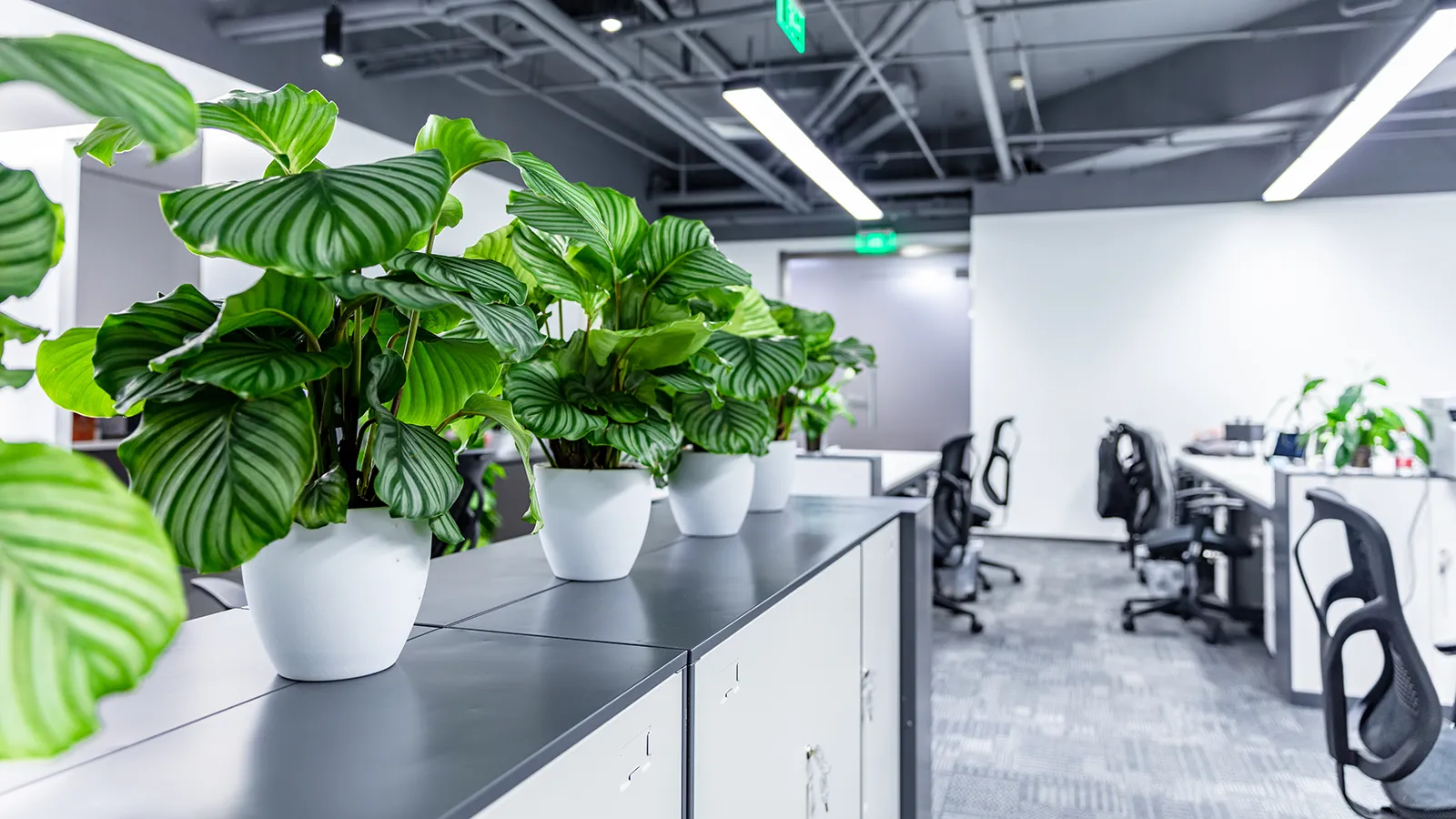
For an office manager or facility manager, bringing plants into a workplace can sound deceptively simple. Choose a few attractive plants, put them in containers, and find someone to water them.
A professionally managed office plant rental program works very differently.
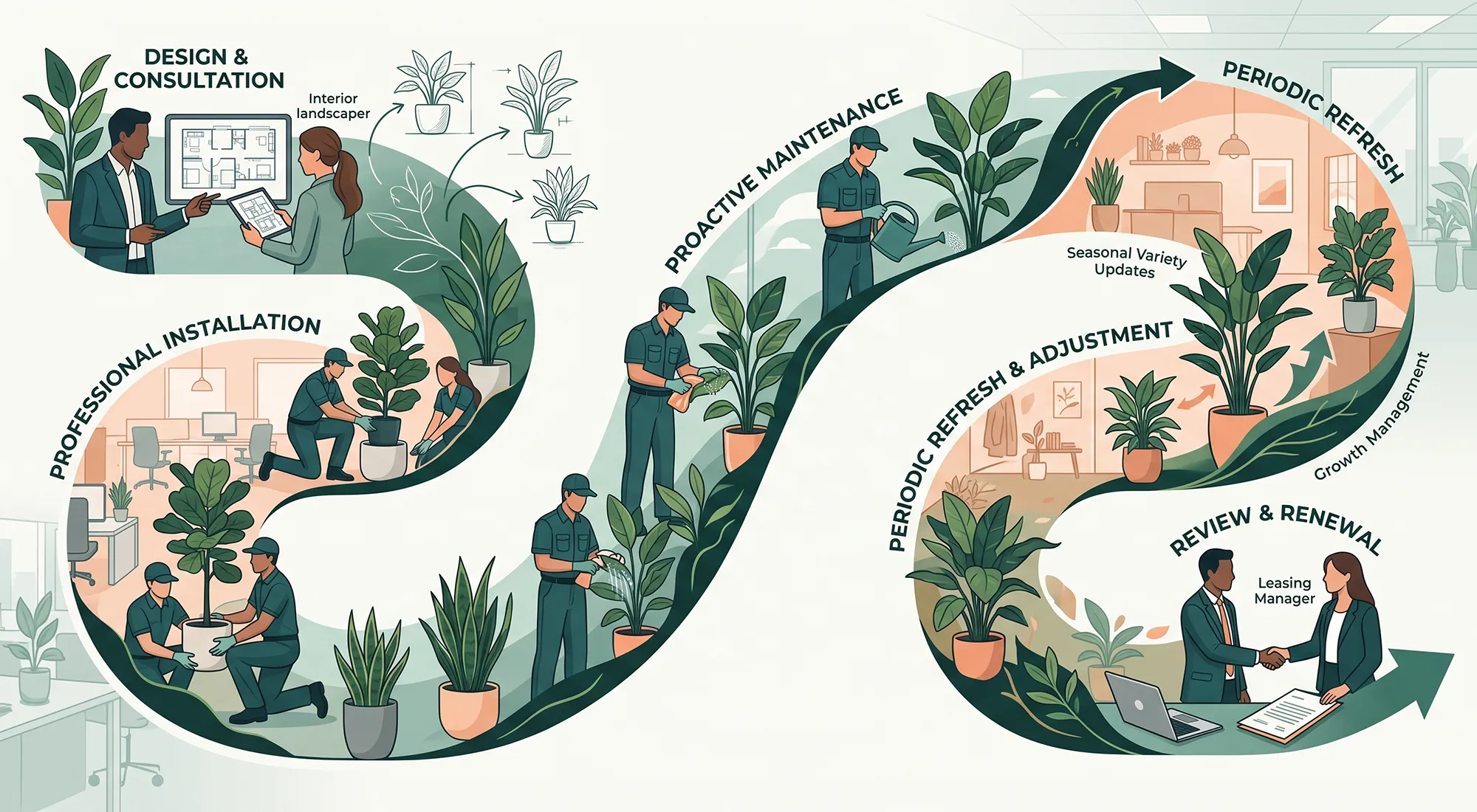
Rather than treating plants as individual decorative purchases, a rental or leasing program treats the entire interior landscape as an ongoing service. The provider helps determine what should be installed, selects plants suited to the building, coordinates containers and placement, handles installation, maintains the plants, replaces them when appropriate, and manages changes as the workplace evolves.
That continuing responsibility is the part that matters most.
For a property manager overseeing a Class A office building, a facility manager responsible for multiple floors, or a business owner who simply wants the office to look polished without becoming responsible for plant care, the question is not just, “What plants do we get?” It is also, “Who is responsible for all of this six months from now?”
Understanding how plant rental for offices works before signing an agreement makes that answer much clearer.
What Office Plant Rental Actually Means
At its simplest, office plant rental gives a business the use of professionally selected plants for an agreed period while the plant provider retains ownership of the leased materials specified in the contract.
In practice, the arrangement can cover considerably more than the plants themselves.
A commercial interior landscape usually includes the live plant, the decorative container, an interior grow pot or liner, growing medium, top dressing, and sometimes specialized watering or sub-irrigation components. The service relationship may also include design, delivery, installation, routine horticultural care, plant replacement, account management, and eventual removal.
That is why it is useful to think of commercial plant rental as a managed plant program rather than a shipment of rented greenery.
The exact arrangement depends on the provider and the agreement. Some businesses lease both plants and containers. Others already own containers and lease the plants that go into them. A property may also have an existing plant collection that a new horticultural provider agrees to maintain.
Amlings, for example, currently offers both leasing and upfront-purchase options for commercial interior landscapes and can also work with clients that already own plants or containers. Its leasing terms are currently offered from one to four years. Amlings interior landscaping FAQ
The financial comparison between leasing and purchasing is a separate question. For someone evaluating how a rental arrangement actually functions, the more useful place to begin is with the space itself.
A Good Rental Program Begins With the Office, Not a Plant Catalog
Professional office plant rental normally starts with a consultation and site assessment.
That matters because commercial interiors can be challenging growing environments. A bright reception area with large windows presents very different conditions from an interior conference room. Plants near an exterior entrance may experience temperature swings. Plants near HVAC equipment can encounter drafts or unusually dry air. A specimen that performs well on one floor may struggle in what appears to be a similar location elsewhere in the building.
Plant selection should respond to those differences.
University of Minnesota Extension recommends matching indoor plants to environmental factors such as available light, temperature, and humidity. It also notes that plants stressed by poor growing conditions can become more susceptible to pest problems. University of Minnesota Extension guidance on indoor plant health
In a commercial setting, the assessment also extends beyond horticulture. Designers need to consider architecture, furnishings, circulation, sightlines, the scale of the room, building access, and the impression the property is trying to make.
A planter in an executive reception area is part of that room’s design. A group of floor plants in a café may soften a large open space or help define seating areas. Plants in a lobby have to hold their visual weight against tall ceilings, large furniture, artwork, and architectural finishes.
Amlings describes its own process as beginning with a consultation and site visit, followed by a design presentation with curated plant and container options. Explore Amlings’ interior landscape design and installation process
That design phase is just as relevant to leased plants as it is to purchased ones. Office plant leasing should not mean settling for whatever happens to be available on a service truck. The goal is still to create an interior landscape that looks intentional in the building.
If you are planning an office plant program and want to understand what could work in your space, explore Amlings’ commercial design, installation, and maintenance services. Learn more about Amlings’ commercial plant services
Who Owns the Plants and Containers?
Ownership is one of the first practical details a facility or property manager should understand.
Under an office plant leasing agreement, the provider will generally retain ownership of the items identified as leased property during the term. But that does not necessarily mean every component of every display has the same ownership status.
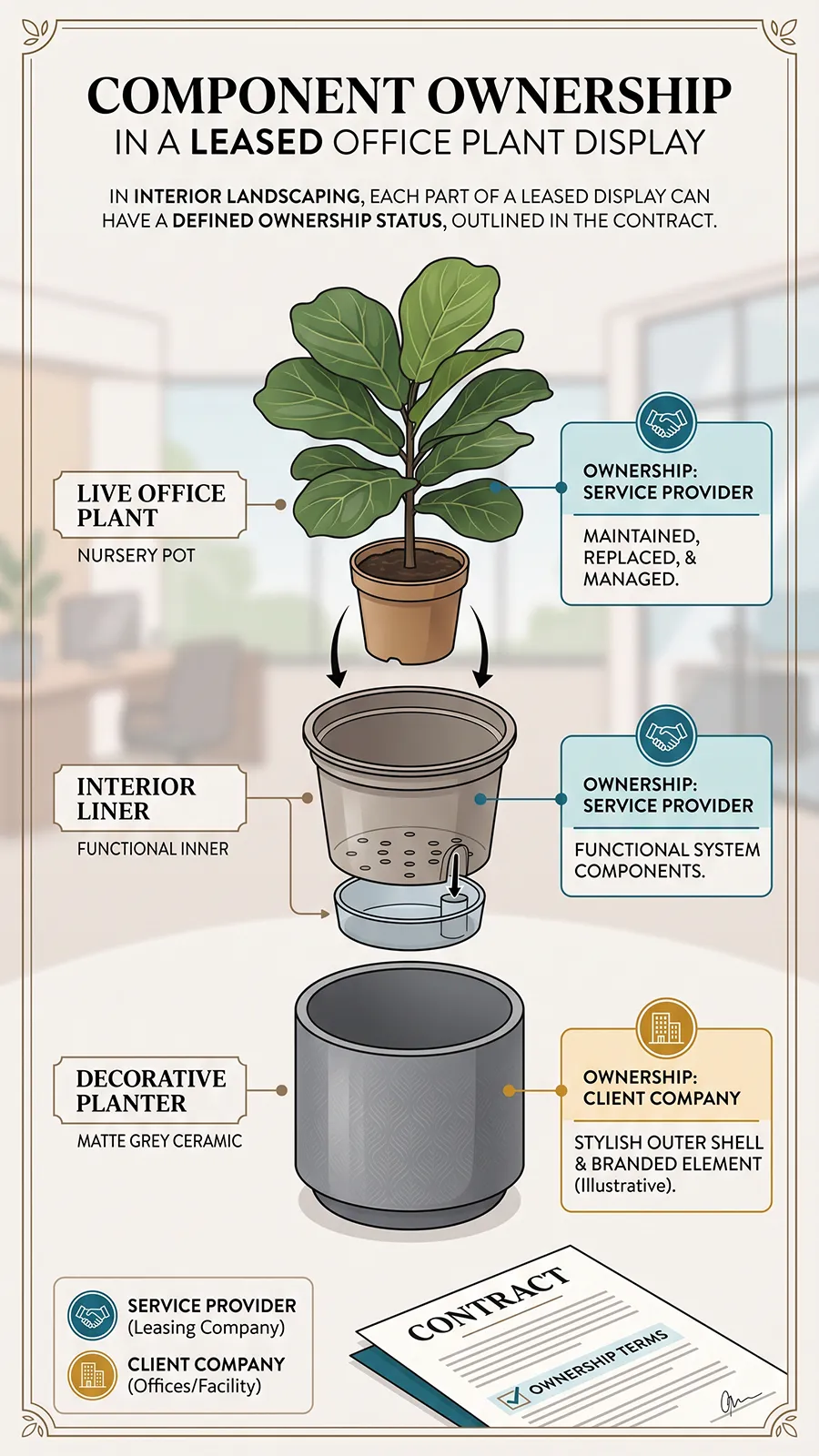
A company could lease the plants and purchase the decorative containers. Another could lease both. A third may already own premium planters from a previous installation and simply need new plants and ongoing maintenance.
None of those structures is inherently unusual. What matters is that the arrangement is documented clearly.
This becomes especially important in a large installation. Imagine a multi-floor headquarters with plants in reception areas, conference rooms, cafés, corridors, executive offices, and collaboration spaces. Several years later, people may no longer remember which containers came from an earlier installation, which were purchased during a renovation, and which belong to the current plant provider.
A good plant leasing service should be able to distinguish leased assets from client-owned property.
That clarity becomes valuable during renovations, vendor transitions, office moves, or the end of the lease. Nobody should be trying to determine ownership from memory while a removal crew is already in the building.
What Happens on Installation Day?
Once the design is approved and the materials are ready, the project moves from concept to installation.
In a small office, that may be relatively straightforward. In a large commercial property, installation can require considerably more coordination.
Plants and containers may need to move through a loading dock, freight elevator, security checkpoint, and occupied tenant areas before reaching their final locations. Building management may require certificates of insurance or advance scheduling. Finished floors may need protection. Large specimens can require specialized handling simply because of their size and weight.
A professional installation team plans for those realities before arriving.
The plants should then be placed according to the approved design, with adjustments made where necessary to account for real-world conditions that were difficult to judge from a floor plan or presentation.
Amlings says its installation process includes advance coordination and on-site designer oversight so the final arrangement remains faithful to the approved design.
Once installation is complete, the commercial plant rental program transitions into something less visible but arguably more important: ongoing care.
The Rental Relationship Really Begins After Installation
Plants are not furniture.
A chair can remain in substantially the same condition whether somebody checks on it next Tuesday or not. A living plant continues responding to light, temperature, moisture, airflow, seasonality, and its own growth.
That is why maintenance is central to office plant rental.
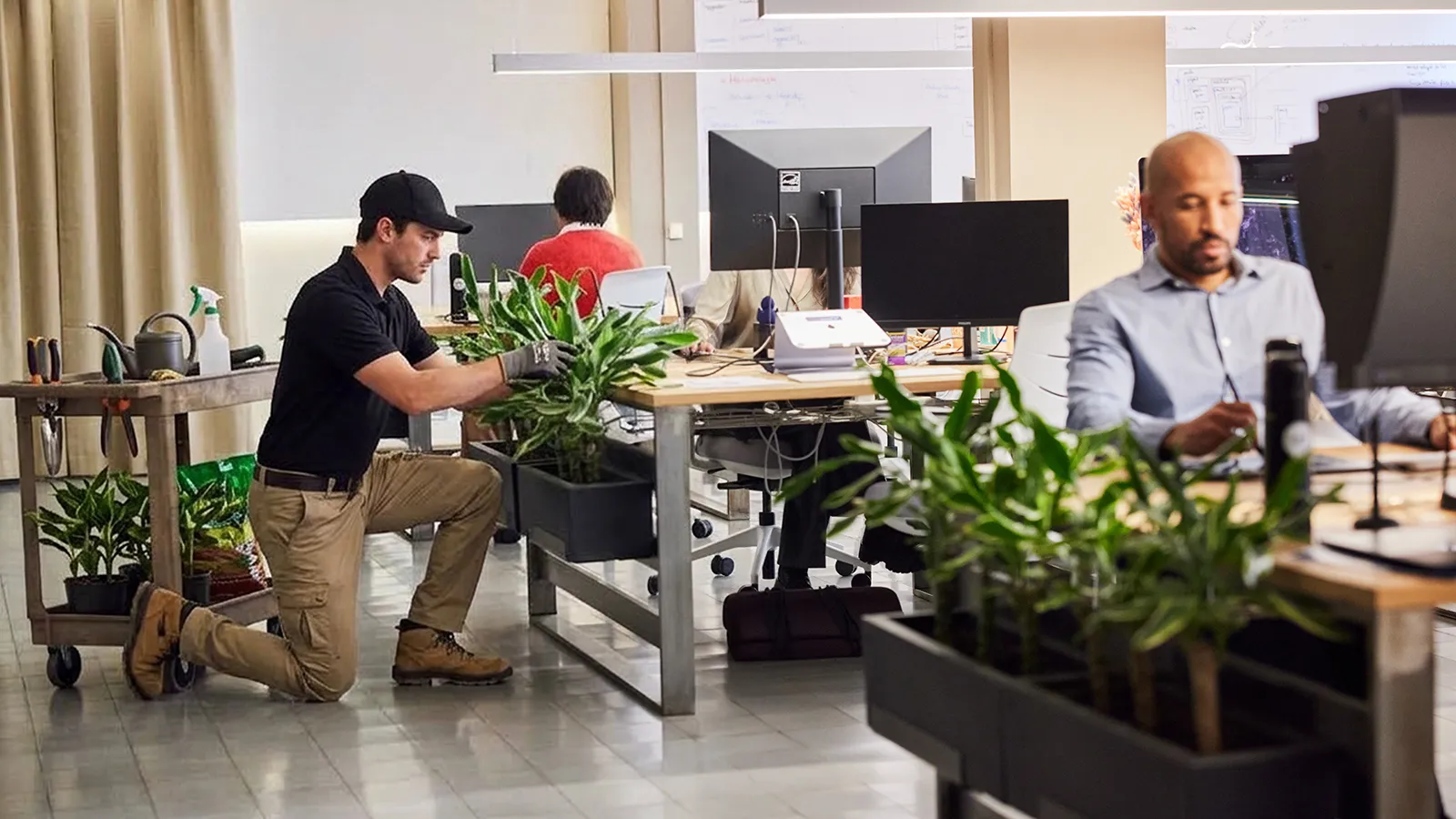
A horticultural technician should be doing much more than adding water. During regular service visits, the technician evaluates plant condition, checks moisture levels, removes damaged foliage, prunes and shapes plants where needed, cleans leaves and containers, watches for pests, and looks for changes in the surrounding environment.
The watering itself also requires judgment. Different plant species, container sizes, root systems, light conditions, and seasonal conditions affect how quickly moisture is used. Treating every plant in a commercial building according to the same rigid watering schedule can create problems rather than prevent them.
Professional maintenance is also useful because it creates continuity. A technician who regularly works in the property can notice gradual changes that an office occupant may not recognize: a plant beginning to thin, a conference-room display receiving less light after furniture has been moved, an HVAC change affecting a particular location, or early signs of an insect problem.
University of Minnesota Extension emphasizes regular inspection, good growing conditions, proper watering, clean plants, and early detection when managing indoor plant health.
The U.S. Environmental Protection Agency likewise advises office occupants to water and maintain plants properly and to clean up excess water promptly. Its broader guidance makes clear that plant care exists alongside, rather than in place of, proper ventilation, moisture control, filtration, and other building-management practices. Read the EPA’s Office Building Occupant’s Guide to Indoor Air Quality
For facility managers, however, the most immediate benefit of professional horticultural care is operational. The plants have an accountable caretaker. Employees do not need to decide whether a plant looks thirsty, the reception team does not inherit watering duties, and the property manager does not have to diagnose why a ficus is suddenly losing leaves.
Amlings provides commercial interior landscape design, installation, leasing, and ongoing horticultural care. To discuss a managed plant program for your property, request a consultation with Amlings. Request an Amlings commercial consultation
What Happens When a Plant Declines?
Even in a professionally maintained installation, not every plant lasts forever.
Plants are living material, and individual specimens can eventually decline because of age, environmental changes, physical damage, pests, or other factors. One of the practical advantages of a managed indoor plant rental program is that there can be an established process for dealing with that decline.
The precise replacement policy should be defined by the service agreement.
That detail deserves attention because “maintenance included” and “replacement included” are not necessarily synonymous. A contract may provide replacement for plants that decline under normal service conditions while excluding damage caused by construction, vandalism, improper relocation, unauthorized watering, prolonged HVAC failures, or other circumstances outside the provider’s control.
The standard for replacement can matter too.
In a high-end commercial property, a plant does not need to be dead before it becomes a problem. A badly thinned, misshapen, or visibly declining plant may no longer meet the appearance standards of an executive reception area or lobby even if it is still biologically alive.
A strong service program recognizes that interior landscaping has both a horticultural standard and a visual one.
Ideally, the service technician notices the decline before the client needs to complain. If the problem can be corrected through pruning, a watering adjustment, relocation, treatment, or another horticultural intervention, that may be the first step. If the plant no longer meets the agreed service standard and qualifies for replacement, the provider can arrange for another specimen.
That process is what makes the replacement component of plant rental for offices different from simply owning a collection of plants and dealing with failures as they happen.
Refreshing a Plant Program Is Different From Replacing a Plant
Not every change happens because something has gone wrong.
An office may be renovated. Furniture may change. A new tenant may take over a floor. Leadership may want a reception area to feel more contemporary. A successful plant may have grown so large that the original composition no longer looks balanced.
Those situations call for a design refresh rather than a horticultural replacement.
A refresh could involve changing the type or scale of plants, updating containers, consolidating several smaller displays into a stronger focal point, or extending greenery into parts of the workplace that were not included in the original installation.
Whether that work falls within the existing office plant leasing agreement depends on its scope. Small adjustments may be relatively simple. A significant redesign with new containers, different plant sizes, or additional installation labor may require a revised proposal or contract amendment.
This is one reason the relationship with the provider matters beyond routine maintenance. A commercial plant program should be able to evolve when the property does.
What Happens When the Office Changes?
Offices rarely remain exactly as they were on installation day.
Departments relocate. Workstations are reconfigured. Conference rooms become offices. Offices become collaboration rooms. Companies expand, consolidate, renovate, or move into other buildings.
The plant program has to respond to those changes without forgetting that plant placement is partly dictated by growing conditions.
An employee may see no problem moving a plant from one end of a floor to the other. Horticulturally, that move could be significant. A plant that has performed well for years near a window may deteriorate after being moved deep into an interior space. A display placed beside a new supply vent may suddenly encounter conditions it did not experience before.
For that reason, substantial plant moves are better coordinated with the plant leasing service than handled casually.
A few plants may simply need new locations. A larger departmental move might require the provider to revisit the floor, reconsider plant suitability, update the inventory, and coordinate relocation with the rest of the move.
Relocating to another building introduces additional questions. The new property may have different light levels, access requirements, loading conditions, or interior design. Some plants may transition easily; others may no longer be appropriate.
The contract should also establish how such moves affect leased property and service responsibilities.
For facility managers, the important point is that a plant lease does not have to freeze the original installation in place. It should provide a clear way to manage change.
Adding or Removing Plants During the Lease
Expansion is common.
A company may begin its office plant rental program in a lobby and executive area, then decide later that it wants plants in conference rooms, cafés, collaboration spaces, or additional floors.
Those displays can often be added to the program, although the provider will need to determine what belongs in the new space and how the addition affects the agreement.
One detail worth clarifying is the contract date for new material. If plants are added halfway through a multi-year lease, do those plants share the original expiration date, or do they begin their own lease period? There is no reason to leave that question unanswered until several years later.
The same principle applies when plants need to be removed.
A business may consolidate its footprint or repurpose a floor. If the plants are leased, simply returning them does not necessarily mean the corresponding contractual obligation disappears immediately. The agreement should explain how partial reductions, removals, and early changes are handled.
Good contract administration may not be the glamorous side of commercial plant rental, but it is what keeps a large program manageable.
Why Accurate Plant Records Matter
A dozen plants in a small office are easy to keep track of informally. Several hundred plants across a corporate campus or commercial portfolio are not.
A professionally managed account should have enough documentation to understand where important displays are located, what belongs to the client, what belongs to the provider, and how the installation has changed over time.
That information becomes especially useful when the regular technician is absent, when a building changes property management companies, when a renovation begins, or when the client decides to move or redesign part of the program.
Good records also prevent a common problem with mature interior landscapes: the physical installation slowly changes while the paperwork does not.
Plants get moved. Containers are replaced. Departments add displays. A renovation eliminates others. After several years, nobody wants to discover that the contract and the building describe two entirely different plant programs.
Office Plants Should Enhance the Workplace, Not Become a Building-System Claim
Commercial plants are commonly associated with the broader benefits of biophilic workplace design, but those benefits should be discussed carefully.
Office plants should not be presented as a substitute for a building’s HVAC system, filtration, ventilation, or professional indoor-air-quality management. EPA guidance identifies pollutant-source management, ventilation, filtration, and moisture control as core elements of indoor air quality in office buildings.
There is, however, research supporting the value of plants as part of the workplace experience.
A series of three field experiments published in the Journal of Experimental Psychology: Applied compared relatively “lean” offices with offices enriched by plants. The researchers reported improved outcomes in the greener workspaces across measures that included workplace satisfaction, concentration, and productivity. One of the study’s authors was affiliated with the University of Exeter. Review the office-plant field study on PubMed
A separate multi-organization field study published in 2023 found significant improvements in areas including perceived workspace attractiveness, workspace satisfaction, and sense of privacy after plants were introduced, while also noting that significant effects were not demonstrated for every outcome researchers measured. Read the 2023 workplace plant study on PubMed
That is a useful context for indoor plant rental. The purpose is not to turn plants into mechanical equipment. It is to incorporate living material thoughtfully into a workplace and then maintain that design so it continues to contribute to the environment.
What Happens When the Lease Approaches Its End?
The end of an office plant lease should not arrive as a surprise.
As the contract approaches expiration, the client and provider have an opportunity to look at the installation as it exists now rather than simply referring back to what was installed several years earlier.
Perhaps most of the program is still working exceptionally well. In that case, renewal may be straightforward.
In another property, the lease expiration may coincide with a natural design refresh. Some containers may no longer complement the furnishings. Plants that were once appropriately scaled may now feel too small for a renovated lobby. New spaces may have been created, while other displays are no longer necessary.
Amlings identifies the contract lifecycle as one of the times when properties often reconsider or upgrade an existing plant program.
If the agreement is not renewed and the provider owns the leased plants or containers, those items will ordinarily need to be removed according to the contract. Building access, freight elevators, security requirements, and removal scheduling can once again become part of the process.
This is also where accurate ownership records become particularly valuable. Client-owned containers should not accidentally disappear with leased plants, and a new service provider should not inherit materials that still belong to the previous vendor.
End-of-term expectations are much easier to manage when they were understood at the beginning.
What Should You Understand Before Signing?
A good office plant rental agreement should make responsibilities understandable rather than forcing the facility manager to discover them one situation at a time.
You should be able to explain, in plain language, who owns the plants and containers, what installation includes, how regularly horticultural service occurs, what happens when a plant declines, and which kinds of replacement are covered.
You should also know what happens if you renovate a floor, move several plants, add another department, reduce the size of the program, relocate the office, or decide not to renew.
The answers do not need to be identical from one provider to another. Commercial properties have different requirements, and contracts can reasonably be structured in different ways.
What matters is that the answers exist.
For property and facility managers, ambiguity is often more troublesome than the rule itself. A clearly written process for changes is easier to manage than discovering an unexpected restriction after a renovation is already underway.
What a Well-Managed Office Plant Rental Program Should Feel Like
When the program is working properly, the client should not spend much time thinking about its mechanics.
The plants fit the space because they were selected for the architecture as well as the growing environment. Installation was coordinated with the building. Horticultural technicians arrive according to the service program and work without disrupting the office. Plants remain groomed and presentable. Problems are caught early. When a plant no longer meets the expected standard, there is a defined way to address it.
If the company renovates or moves, there is someone to call who already understands the installation.
That is what separates a professionally managed plant rental for offices from merely having potted plants scattered around a workplace.
Amlings describes its approach as design-led from the beginning, with plant and container selections intended to complement a property’s architecture, finishes, brand, and audience. Its ongoing horticultural service then carries that design through after installation.
For office managers, facility managers, property managers, and business owners, that continuity is the point. The goal is not to become experts in watering schedules, plant replacement, container inventories, or relocation logistics. It is to have an interior landscape that is professionally managed as part of the property.
Office Plant Rental Is a Service Relationship, Not Just a Transaction
The easiest way to understand office plant rental is to stop thinking about it as temporarily acquiring plants.
The plants are only the most visible part of the relationship.
Behind them are design decisions, site conditions, installation logistics, ownership responsibilities, horticultural care, replacement standards, account records, workplace changes, contract amendments, and end-of-term planning.
When those elements are managed well, the result can feel remarkably simple from the client’s perspective: the office has healthy, attractive plants, and somebody knowledgeable remains responsible for keeping it that way.
That is ultimately what a strong commercial plant rental program should accomplish.
It gives a business a professionally designed interior landscape while placing the ongoing horticultural work in the hands of specialists. As the office changes, the plant program can change with it. And when the lease reaches the end of its term, the next step—whether renewal, redesign, modification, or removal—is already understood.