

Choosing among biophilic design companies is different from hiring a conventional interior decorator, plant supplier, or maintenance vendor. A successful commercial biophilic project involves living materials that must work with the architecture, lighting, HVAC conditions, traffic patterns, construction schedule, brand standards, maintenance requirements, and long-term operations of the property.
For architects and interior designers, the right partner must understand design intent. For developers and corporate real estate teams, the company must coordinate reliably with contractors and building management. For property managers, the finished installation must still look intentional months and years after opening day.
That is why the strongest biophilic design companies do more than specify attractive greenery. They connect design, horticulture, procurement, installation, maintenance, replacements, and future changes into one workable program.
The underlying idea is supported by a growing body of research. The U.S. General Services Administration describes biophilic design as the strategic use of natural features to support positive physiological, cognitive, social, and psychological experiences. Its guidance connects elements including indoor plants, daylight, and views of nature with outcomes such as stress reduction, mood, and cognitive performance. Read the GSA Buildings and Health guidance on biophilic design.
Research also suggests that workplace plants can affect how occupants perceive and experience their environments. A field study involving multiple organizations found improvements in factors including perceived workspace attractiveness, satisfaction, privacy, and complaints about dry air after plants were introduced. Importantly, the researchers did not find significant effects for every outcome they measured—a useful reminder to choose a partner that presents biophilic design credibly rather than making exaggerated wellness claims. Read the workplace plant study through the National Library of Medicine.
If you are preparing a new construction project, repositioning an existing property, updating a workplace, or replacing an underperforming plant vendor, the following nine criteria can help you choose a company capable of delivering a dependable commercial biophilic design program.
1. Decide What You Actually Need From a Biophilic Design Firm
Start by defining the role you expect the company to play.
The term biophilic design can describe a broad range of work. One biophilic design consultant may focus primarily on strategy and environmental design principles. Another company may specialize in interior landscaping and living plant systems. Some firms provide design but outsource installation or maintenance. Others provide the entire lifecycle themselves.
For most commercial properties, useful biophilic design services may include:
- Early design consultation
- Site assessment
- Review of architectural plans
- Light and environmental evaluation
- Plant and container specification
- Interior landscape plans
- Living-wall design
- Coordination with architects and interior designers
- Procurement
- Delivery and installation
- Ongoing horticultural maintenance
- Plant replacement
- Future additions and relocations
- Portfolio-wide standards
- Seasonal or periodic design refreshes
A company does not necessarily need to perform every service internally. It does need to make responsibilities clear.
Ask who is responsible for design development, plant selection, container procurement, irrigation systems, supplemental plant lighting, structural coordination, installation, maintenance, and warranty or replacement issues.
When several companies share the work, also ask who owns final accountability.
A beautiful concept is not enough if every problem later becomes somebody else’s responsibility.
If you want one commercial partner involved from consultation through installation and ongoing care, explore Amlings’ interior landscape design, installation, maintenance, and living-wall services. Amlings works specifically with commercial accounts and can be engaged to develop a biophilic program around your property, architecture, and operational requirements.
2. Look for Commercial Biophilic Design Experience
Residential plant styling and commercial biophilic design involve very different operating conditions.
A commercial provider may need to navigate:
- Construction schedules
- General contractors
- Freight elevators
- Loading-dock reservations
- Security requirements
- Certificates of insurance
- High-rise access
- Union or building rules
- Occupied workspaces
- After-hours installation
- Floor and furniture protection
- Large specimens
- Custom containers
- Multiple tenant areas
- Portfolio standards
- Facilities and engineering teams
Review the company’s portfolio, but do more than judge photographs.
Ask what role the firm actually performed on each project.
Did it develop the design? Did it specify the plants? Did it coordinate with the architect? Did another contractor install the infrastructure? Does the same company maintain the installation today?
A useful portfolio demonstrates not only that a biophilic design firm can make a space photograph well at completion, but that it understands the constraints of commercial environments.
This is especially important for large atriums, hospitality properties, corporate headquarters, healthcare settings, multi-building portfolios, and projects involving living walls or built-in planting systems.
3. Make Sure the Company Understands Biophilic Design Beyond Potted Plants
Plants are an important tool, but biophilic design is broader than putting greenery into empty corners.
Terrapin Bright Green’s influential 14 Patterns of Biophilic Design organizes biophilic experiences into categories including direct connections with natural systems, natural analogues, and spatial conditions such as prospect and refuge. Its framework includes visual connections with nature, non-rhythmic sensory stimuli, material connections with nature, complexity and order, and other patterns designers can use when planning built environments. Review the 14 Patterns of Biophilic Design.
An experienced company should therefore ask questions such as:
Where are the major sightlines?
Which areas should feel restorative?
Where do people gather, pause, collaborate, or transition between spaces?
Can plants create softer spatial boundaries?
Can a planting feature reinforce wayfinding?
Should the design emphasize immersion, architectural rhythm, texture, screening, scale, or a dramatic focal point?
How will plant material relate to flooring, millwork, furnishings, lighting, artwork, and brand standards?
The goal is not maximum plant quantity. It is purposeful placement.
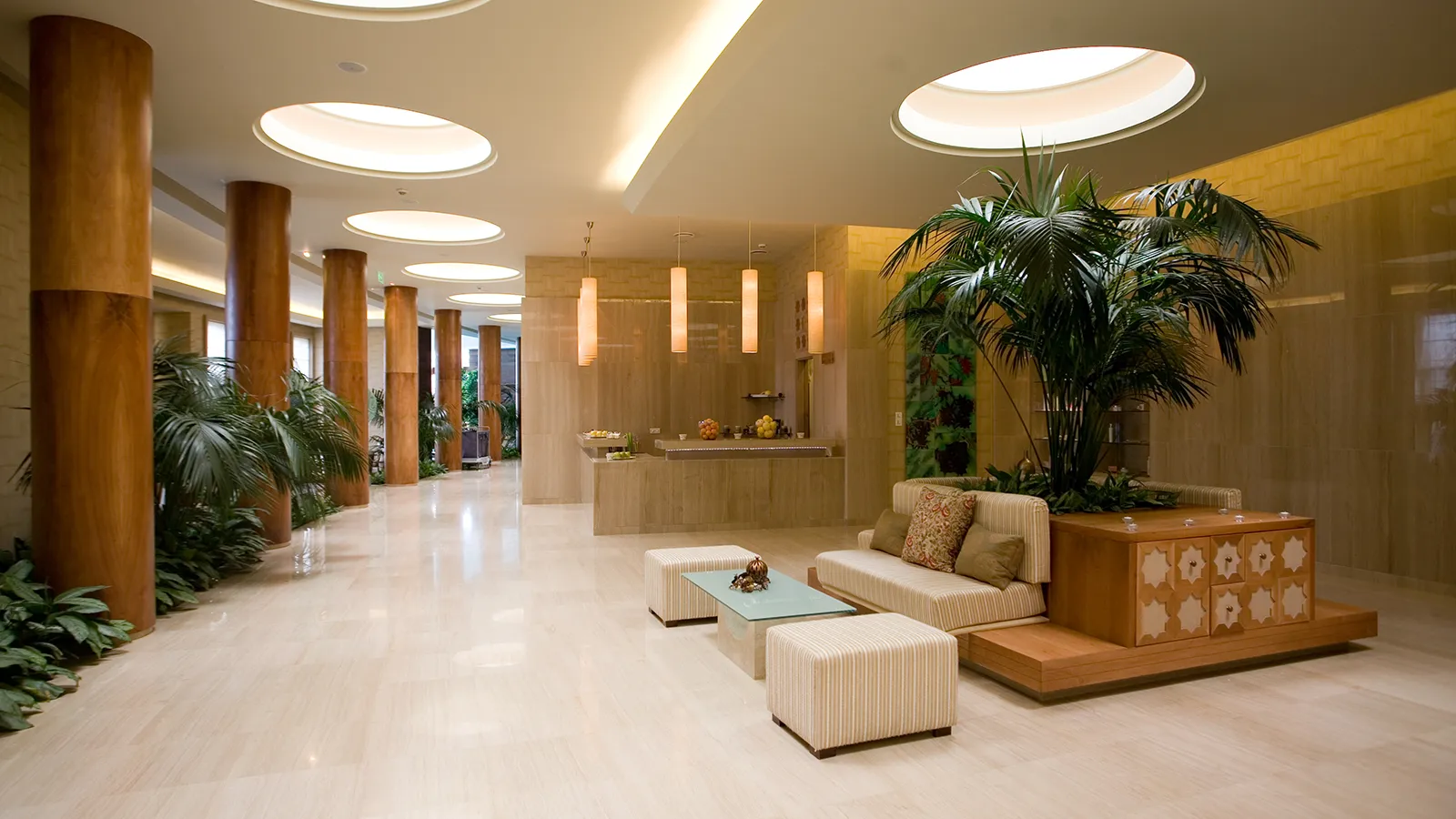
4. Evaluate the Company’s Horticultural and Technical Process
Plants are living design materials, which makes environmental analysis essential.
A bright-looking lobby may not provide enough usable light for the species shown in a rendering. A plant beside an exterior door may experience damaging winter drafts. HVAC outlets can create localized temperature or moisture problems. A planter that works beautifully in one part of a floor can fail in another.
A capable biophilic design consultant or plantscape company should evaluate factors such as:
- Available daylight
- Supplemental plant lighting
- HVAC exposure
- Temperature
- Humidity
- Water access
- Drainage
- Traffic
- Maintenance access
- Container dimensions
- Mature plant size
- Sightlines
- Safety
- Building operations
The provider should then be able to explain why particular species were selected.
Harvard’s Healthy Buildings program includes access to nature and nature-inspired interior design among the considerations associated with healthier buildings, reinforcing the larger principle that occupant experience should be considered alongside traditional building systems. Explore Harvard’s 9 Foundations of a Healthy Building.
But the health of the plants matters too. A biophilic environment filled with declining greenery works against the design objective.
That makes horticultural expertise just as important as concept development.
5. Understand Exactly How Plant and Container Leasing Works
This is one of the most important areas to clarify when interviewing biophilic design companies.
Plant leasing is not simply a financing term. It determines who owns the physical assets, who can modify them, what happens when plants decline, and what must occur when the contract changes or ends.
The exact structure varies by provider, so the proposal and contract should control. However, a commercial plant lease commonly works like this:
Who Owns the Plants and Containers?
For assets identified as leased, the plants and containers generally remain the property of the provider for the duration of the agreement unless the contract states otherwise.
There can also be hybrid arrangements.
For example:
- The provider owns both plants and containers.
- The provider owns the plants while the client owns the containers.
- The client already owns plants and containers and hires the company only for maintenance.
- Certain custom-built features belong to the property while replaceable plant material remains part of the service program.
Do not assume ownership. Put it in writing.
Amlings’ current FAQ confirms that the company offers both plant and container leasing as well as upfront purchase arrangements. It also notes leasing terms ranging from one to four years. Review Amlings’ plant and container leasing FAQ.
What Happens During Installation?
A lease should identify whether installation is included in the initial scope or handled as a separate project component.
Clarify responsibility for:
- Delivery
- Freight and staging
- Freight-elevator reservations
- Floor protection
- Plant preparation
- Decorative containers
- Waterproof liners
- Placement
- Cleanup
- Asset inventory
- Installation supervision
For a larger project, the final inventory should document what was actually installed and where it is located.
How Does Maintenance Work?
Leasing does not automatically tell you what maintenance includes.
The service scope should state whether technicians provide watering, moisture monitoring, pruning, grooming, cleaning, fertilization, pest monitoring, plant rotation, reporting, and other horticultural services.
Amlings describes its ongoing service as year-round professional care including watering, grooming, and proactive problem-solving. Learn about Amlings’ commercial design and maintenance process.
For a more detailed explanation of what a professional service agreement should contain, review Amlings’ guide to commercial plant maintenance services.
How Are Plant Replacements Handled?
Replacement is a particularly important contract term.
Plants are living material. Even under professional care, individual specimens can eventually decline.
Ask:
- Are normal replacements included?
- What conditions are excluded?
- Who determines when replacement is appropriate?
- How quickly will a declining plant be removed?
- Will replacements match the original species and size?
- Can the provider substitute another plant better suited to the location?
- Does client-caused damage create an additional charge?
- What happens after construction activity, HVAC failures, vandalism, relocation, or prolonged access restrictions?
A replacement policy should protect the design standard, not merely promise that something green will eventually occupy the container.
What Is a Refresh?
A refresh is different from a replacement.
Replacement normally addresses an individual plant that is no longer performing appropriately.
A refresh is a planned design change.
That could involve changing plant varieties, updating containers, altering groupings, modifying colors or finishes, adjusting scale, or modernizing the overall plant program after an interior renovation.
Ask whether refreshes are included, scheduled periodically, or handled through a separate proposal.
What Happens When You Add or Remove Plants?
Commercial interiors change.
A tenant expands. A lounge is converted into meeting space. A reception area is remodeled. A new floor opens.
Your contract should explain how additions and removals work.
Typically, the provider will prepare a change order or contract amendment identifying the revised inventory, installation requirements, and ongoing service scope.
Do not allow the physical installation and contractual inventory to drift apart. When twelve planters become twenty, or twenty become fourteen, the written program should change with them.
Can Leased Plants Be Moved?
Usually, they can be relocated with coordination, but the provider should evaluate the new conditions first.
A plant thriving beside a window may fail in an interior conference room.
Large containers may also require professional handling to avoid damage to the vessel, flooring, irrigation components, or the plant itself.
Ask whether client personnel are permitted to relocate leased displays or whether moves must be performed or approved by the plant company.
How Are Contract Changes Managed?
Look for a straightforward process for adjusting:
- Plant quantities
- Locations
- Container selections
- Service areas
- Visit requirements
- Building access
- Newly occupied floors
- Vacated floors
- Renovation phases
For a portfolio client, determine whether individual locations can be modified under a master agreement.
What Happens at the End of the Term?
This should never be left vague.
If the contract is renewed, leased assets may simply remain in place under the new agreement, subject to whatever updates the parties approve.
If the agreement ends, determine:
- Which plants belong to the provider
- Which containers belong to the provider
- Which items belong to the client
- Who schedules removal
- Whether removal is included
- Whether restoration or cleanup is required
- How damaged or missing leased containers are handled
- How open replacement issues are resolved
- Whether any assets can be purchased or transferred
- How much notice is required
- What access the provider needs for deinstallation
Unless ownership transfer is explicitly written into the agreement, do not assume that leased plants or containers become the client’s property at expiration.
The point is not to compare leasing with purchasing. The point is to know precisely how the arrangement operates from installation through exit.
Amlings offers commercial plant and container leasing in addition to design, installation, and ongoing maintenance. To purchase Amlings’ professional biophilic design and plant services for your commercial property, request a project consultation with Amlings.
6. Compare Maintenance and Replacement Standards
A project should not be evaluated solely on opening-day photography.
Ask each provider what the installation is supposed to look like after six months, one year, and several years.
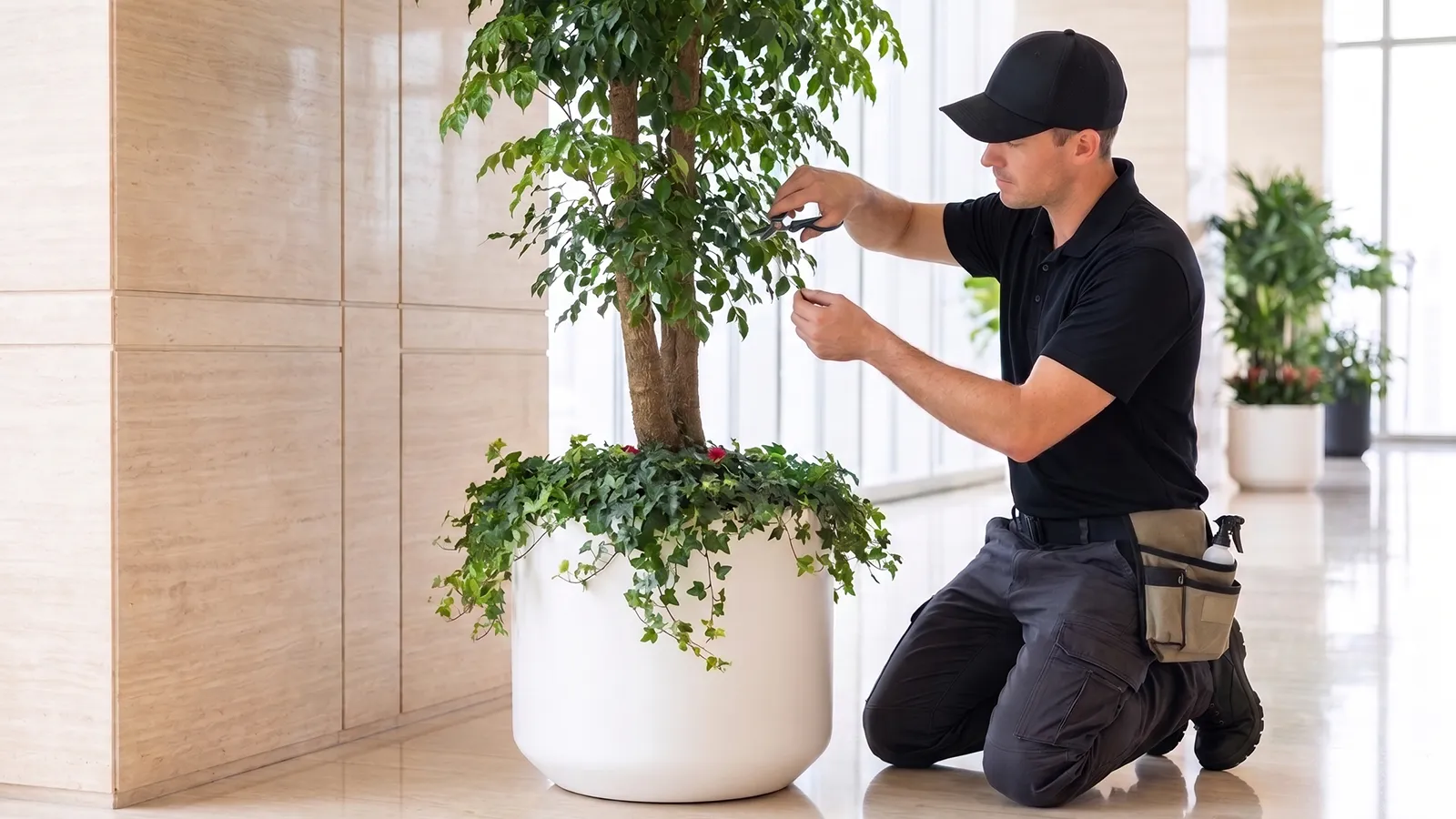
Professional maintenance should address both horticultural health and presentation quality.
Depending on the installation, routine work may include:
- Condition-based watering
- Moisture testing
- Pruning
- Shaping
- Grooming
- Leaf cleaning
- Container cleaning
- Fertilization
- Pest monitoring
- Rotation
- Irrigation checks
- Replacement recommendations
- Service documentation
- Quality-control inspections
The distinction between keeping plants alive and maintaining the design matters.
A plant can technically survive while becoming sparse, misshapen, dusty, oversized, or visually unsuitable for its intended location.
Ask whether supervisors periodically inspect the work and whether the provider uses a defined appearance standard.
The University of Exeter reported findings from a real-office study in which adding plants to previously sparse offices was associated with improvements in workplace satisfaction and measured productivity. That does not mean every plant installation produces the same outcome, but it helps explain why the quality of the environment—not merely the presence of individual plants—deserves attention. Read the University of Exeter office plant study summary.
7. Ask How the Company Coordinates With Architects and Designers
Architects and interior designers should look for a partner that can enter the project before the planting package becomes an afterthought.
Early coordination can resolve issues involving:
- Planter dimensions
- Built-in planter details
- Drainage
- Waterproofing
- Irrigation
- Electrical service
- Supplemental lighting
- Floor loading
- Wall support
- Maintenance access
- Water supply
- Furniture clearances
- Circulation
- Construction sequencing
This becomes particularly important with living walls, large trees, custom planters, atrium installations, and features integrated into millwork.
A good biophilic design firm should also know how to support another designer’s vision rather than compete with it.
Ask how the company communicates specifications. Can it review plans? Mark up drawings? Provide dimensions and product information? Coordinate samples? Attend design meetings? Work with contractors? Respond to substitutions?
For architecture and interior design teams, this ability may matter as much as the final plant palette.
8. Use a “Biophilic Design Near Me” Search as a Starting Point, Not the Final Test
Searching biophilic design near me is a reasonable way to develop an initial shortlist, especially when the project requires ongoing maintenance.
Local presence can matter because plants require physical service. Technicians need to reach the property consistently. Replacements need to arrive promptly. Account managers may need to inspect an issue in person. Complex installations may require repeated coordination with property staff.
But geographic proximity alone tells you very little about capability.
After searching biophilic design near me, evaluate each candidate based on:
- Commercial project experience
- Design quality
- Horticultural expertise
- Service area
- Installation capacity
- Maintenance staffing
- Response procedures
- References
- Insurance
- Project coordination
- Leasing terms
- Replacement policy
- Quality control
For a Chicago-area project, Amlings states that it works specifically with commercial properties and provides interior landscape design and installation, ongoing maintenance, living walls, exterior displays, and seasonal installations. See Amlings’ commercial biophilic design services.
9. Interview Biophilic Design Companies With the Same Questions
The easiest way to compare proposals is to ask every candidate the same questions.
Use this checklist during interviews:
| Question | What You Are Trying to Learn |
|---|---|
| Who will lead the design? | Whether design expertise is internal and accountable |
| What commercial projects are comparable to ours? | Relevant experience |
| How do you evaluate light and environmental conditions? | Horticultural rigor |
| How will you coordinate with our architect or interior designer? | Project-team compatibility |
| What is included in your biophilic design services? | Scope clarity |
| Who owns plants and containers under a lease? | Asset responsibility |
| Who handles installation? | Operational accountability |
| What maintenance is included? | Long-term service standard |
| What is your replacement policy? | Appearance protection |
| How are planned refreshes handled? | Long-term design management |
| How do additions and removals work? | Flexibility |
| What happens if our space is renovated or we move? | Change-management capability |
| How are contract amendments documented? | Administrative clarity |
| What happens to leased assets at termination? | End-of-term expectations |
| How is maintenance quality inspected? | Quality assurance |
| Can you provide comparable references? | Verification |
Also pay attention to the questions the provider asks you.
The best biophilic design companies should want to understand your architecture, occupants, brand, operating requirements, schedule, existing plant inventory, maintenance expectations, and long-term goals.
A vendor that begins prescribing plants before understanding the space may be approaching the project as a product sale rather than a design problem.
Red Flags When Comparing Biophilic Design Companies
Several warning signs deserve additional scrutiny.
The Proposal Is Visually Attractive but Operationally Vague
Renderings should be accompanied by a clear scope.
You should understand who supplies, installs, owns, maintains, replaces, moves, and eventually removes each component.
Every Plant Is Recommended Everywhere
Plant selection should respond to environmental conditions.
A provider that ignores light, airflow, temperature, or maintenance access is designing for installation day rather than long-term success.
Maintenance Is Described Only as “Watering”
Professional commercial horticulture involves much more than adding water.
Replacement Terms Are Missing
Do not wait for the first declining lobby plant to discover the replacement process.
Nobody Can Explain the End of the Lease
If the company cannot tell you what happens to plants and containers when the agreement expires, obtain clarification before signing.
Wellness Claims Sound Too Good to Be True
Biophilic design has a meaningful research base, but evidence quality varies by intervention and outcome. A 2026 systematic review of restorative workplace interventions noted significant methodological gaps and found that restorative qualities are often assumed rather than measured directly. A credible biophilic design consultant should be comfortable distinguishing established evidence, promising research, and marketing claims. Read the 2026 systematic review in the Journal of Environmental Psychology.
What a Strong Biophilic Design Company Proposal Should Contain
Before making a final selection, make sure the proposal gives your team enough information to understand both the design and the relationship.
A comprehensive proposal may include:
- Project goals
- Areas included
- Concept imagery
- Plant selections
- Container selections
- Quantities
- Sizes
- Locations
- Environmental considerations
- Installation responsibilities
- Project schedule
- Ownership structure
- Leasing terms
- Maintenance scope
- Service frequency
- Replacement terms
- Refresh policy
- Addition and removal procedures
- Relocation procedures
- Change-order process
- Contract term
- Renewal requirements
- Termination requirements
- End-of-term asset handling
- Client responsibilities
- Provider responsibilities
The more operationally significant the project, the less you should rely on assumptions.
If your project is still in early planning, review Amlings’ commercial design and installation process to see the typical progression from consultation and site review through design, installation, and ongoing maintenance.
Choosing the Right Partner Is About the Full Lifecycle
The best biophilic design companies should be able to answer three questions clearly:
What should this space become?
How will we build it correctly?
How will we keep it looking that way?
That requires more than beautiful plants.
For architects and interior designers, the right company becomes a specialist capable of translating design intent into living material.
For developers and corporate real estate teams, it becomes a project partner that can coordinate procurement, installation, and changing occupancy requirements.
For property managers, it becomes an ongoing service provider responsible for maintaining the appearance of the installation long after the ribbon cutting.
And when plants or containers are leased, the relationship should be especially clear. Ownership, installation, maintenance, replacements, refreshes, additions, removals, moves, contract changes, renewal, and end-of-term removal should all be understood before work begins.
That clarity is what separates a dependable commercial plant program from a collection of attractive objects that eventually becomes somebody else’s operational problem.
If you are evaluating biophilic design companies for a Chicago-area commercial project, Amlings provides design, installation, plant and container leasing options, ongoing horticultural maintenance, and living-wall services for commercial environments.
Ready to purchase Amlings’ biophilic design services for your property? Contact Amlings and request a commercial project consultation to discuss your architectural plans, existing space, leasing requirements, installation schedule, and long-term maintenance goals.