
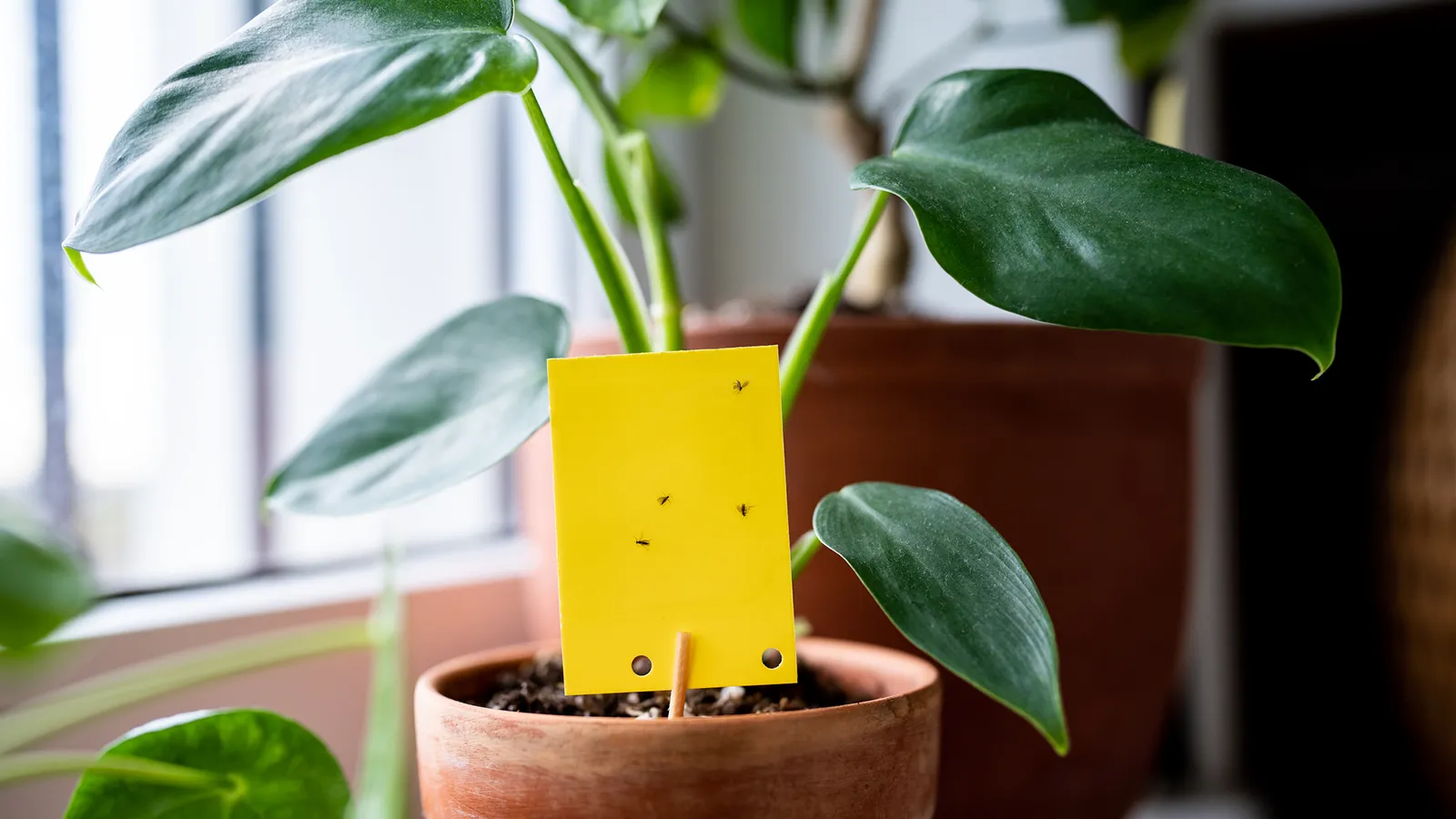
The best way to get rid of fungus gnats in office plants is to identify their source, correct overly damp growing conditions, monitor adult insects, and address larvae when necessary. Yellow sticky traps can help catch adult gnats, but traps alone rarely solve an ongoing infestation because the larvae develop in moist potting media.
For persistent infestations, Amlings also uses targeted treatments such as Bacillus thuringiensis israelensis (Bti) and beneficial nematodes, along with replacing the upper layer of moist growing medium when appropriate. These measures help address developing fungus gnats beneath the soil surface, not just the adults flying around the office.
For Chicago office managers and property managers, the goal is to resolve the issue without damaging the plants, disrupting employees, or turning one small complaint into a recurring building problem.
Here’s what to look for, what actually works, and when professional plant care can help.
Key Takeaways
- Fungus gnats are usually more annoying than dangerous. Adults don’t bite people and generally cause little direct harm to established office plants.
- Excessively damp growing media often contribute to infestations. However, proper watering depends on the plant and container.
- Sticky traps only address adult gnats. Amlings also uses Bti and beneficial nematodes to target larvae and typically replaces the upper layer of moist soil in affected planters when appropriate.
- Identify the source before treating. Small flying insects around a commercial building aren’t always coming from plants.
- Prevention depends on consistent care. Appropriate watering, clean containers, monitoring, and follow-up can help reduce recurring problems.
What Are Fungus Gnats in Office Plants?
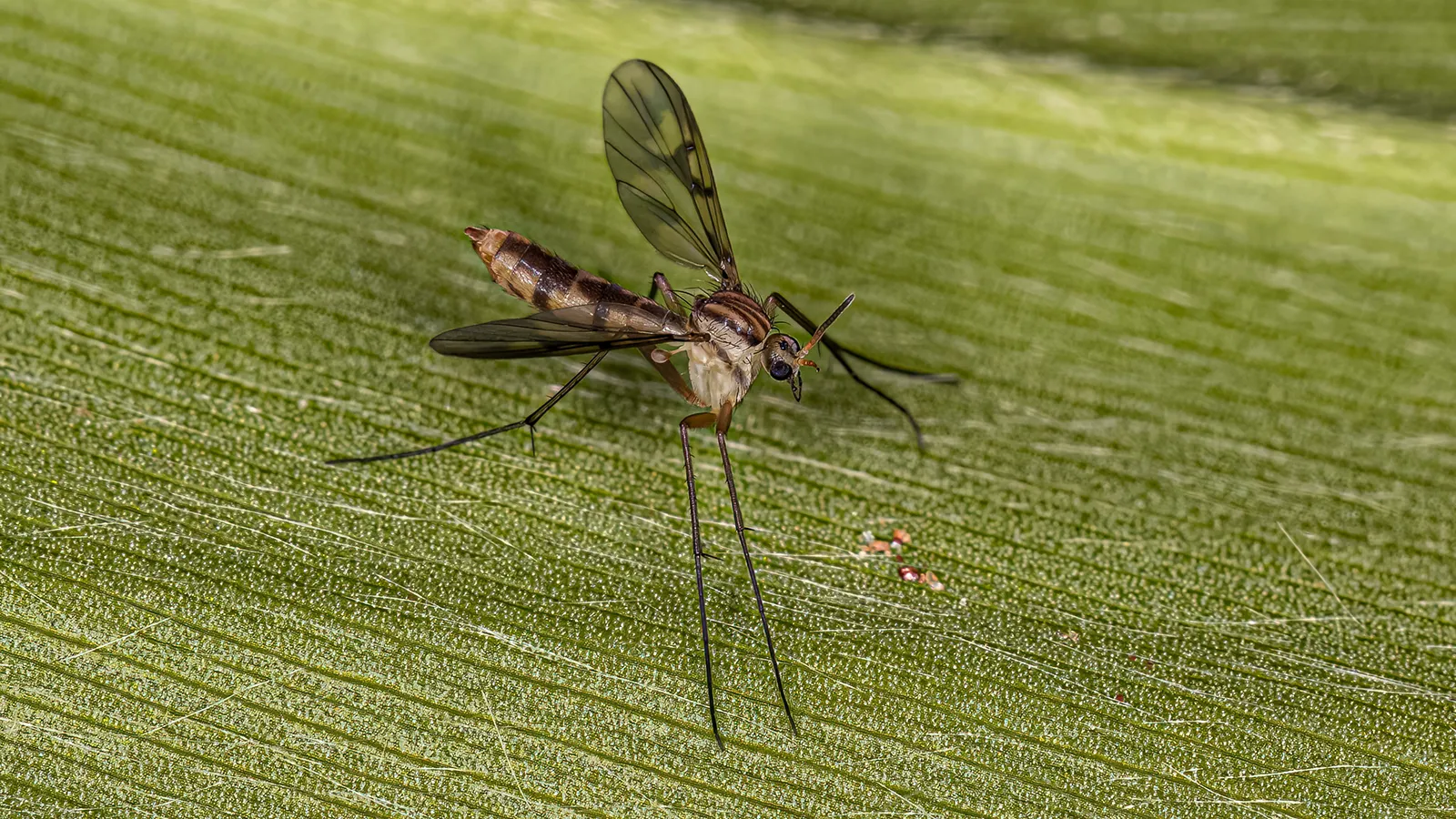
Fungus gnats are small, dark-colored flies often found around the soil of indoor plants.
They belong to several groups of fungus-associated flies, with dark-winged fungus gnats in the family Sciaridae particularly common around potted plants.
The adults typically have slender bodies, long legs, and delicate wings. They can resemble tiny mosquitoes.
You’ll often notice them moving around planters, walking across the surface of potting media, or flying near windows and light fixtures.
But here’s the important part: the flying insects are only one stage of the problem.
Fungus gnats lay eggs in suitable moist growing media. Their larvae live within the substrate, where they feed primarily on fungi, microorganisms, and decaying organic material.
This explains why simply catching the adults may not resolve an established infestation.
The University of Minnesota Extension explains that fungus gnats prefer damp potting soil and are generally nuisance pests in established houseplants.
Are Fungus Gnats Harmful to Office Plants?
Usually, the biggest issue is their presence.
Adult fungus gnats don’t bite and don’t directly feed on people.
In typical established indoor plant arrangements, they are generally more of a nuisance than a major source of plant damage.
However, high populations of larvae can sometimes damage tender roots, particularly in young or vulnerable plants.
If an office plant is yellowing, wilting, or dropping leaves, don’t automatically assume the gnats are responsible.
The plant may be experiencing excessive moisture, inadequate light, poor drainage, or another issue that needs investigation.
Why Do Fungus Gnats Appear in Office Plants?
The most common contributing condition is persistently moist growing soil and environment..
Fungus gnat larvae benefit from the fungi and organic material associated with damp conditions.
That doesn’t mean every affected plant was improperly watered.
An infestation may also be introduced through new plants or contaminated potting media.
And some commercial plant containers retain moisture longer than expected because of their size, drainage arrangements, or location.
Overwatering Can Create Favorable Conditions
It’s easy to assume that watering an office plant regularly is the safest approach.
But plants don’t all need water at the same frequency.
A large tropical specimen near a bright window may use water differently from a similar plant in a dim interior conference room.
If both receive identical amounts on the same schedule, one may remain wetter than appropriate.
Repeated overwatering can encourage the conditions fungus gnats prefer.
Poor Drainage Can Keep Growing Plants Too Wet
Decorative commercial planters sometimes use interior grow pots, liners, drainage trays, or other arrangements to protect surrounding surfaces.
These systems need to be managed correctly.
If excess irrigation water remains in a container, the plant’s root environment may stay too wet.
That can contribute to both fungus gnat activity and plant-health concerns.
The right solution depends on how the planting system is constructed.
New Plants May Introduce Pests
An office may have an excellent maintenance routine and still encounter pests after introducing new plants.
Fungus gnats can travel with plants and growing media.
Inspecting new material before it joins an established interior landscape is a useful preventive measure.
Existing Moisture Problems May Go Unnoticed
Sometimes a plant looks perfectly acceptable above the surface while the growing medium remains excessively wet below.
That’s why visual inspection alone doesn’t reveal everything about the plant’s condition.
A horticultural evaluation may need to include moisture assessment, drainage, and the physical condition of the root environment.
How to Get Rid of Fungus Gnats in Office Plants: Five Steps
If employees are noticing small insects around a lobby planter or conference room plant, there’s no need to panic.
The most productive response is organized and focused on the source.
Step 1: Confirm You’re Dealing With Fungus Gnats
Before applying treatments, establish what kind of insect you’re seeing.
Fungus gnats are commonly confused with fruit flies and drain flies.
These insects have different breeding environments, so their management can differ.
Check whether activity is concentrated near potted plants, the soil surface, or nearby windows.
If possible, document the insects with a clear photograph.
A qualified horticultural technician or pest-management professional can help with identification.
Step 2: Find the Affected Containers
Start with the plants nearest the reported activity.
Look for adults moving around the growing medium.
Consider placing yellow sticky monitoring cards near the suspected containers, away from areas where people or clothing could contact the adhesive.
The University of Minnesota Extension recommends yellow sticky cards as a way to detect and capture adult fungus gnats.
Monitoring can help determine which plants are involved and whether the number of adults is changing.
Don’t assume every plant in the building is infested just because insects appear in one area.
Step 3: Review Watering and Drainage
Once a suspected source is identified, investigate moisture conditions.
Is the growing medium staying wet between maintenance visits?
Does the container drain appropriately?
Is excess water collecting in an interior liner?
Are employees adding water independently of the regular maintenance schedule?
These questions matter because an effective solution should address the conditions supporting the insect population.
The objective is not to withhold water until the plant suffers.
It’s to maintain moisture levels suitable for the particular plant while avoiding unnecessary saturation.
Step 4: Determine Whether Additional Treatment Is Necessary
Correcting growing conditions and monitoring adults may be sufficient for a minor problem. Persistent infestations may require additional treatment directed at larvae.
Amlings uses Bacillus thuringiensis israelensis (Bti) and beneficial nematodes to target fungus gnat larvae in the growing medium. Our team also typically replaces the top few inches of moist soil, where fungus gnats commonly lay eggs, when appropriate for the plant.
These methods work alongside proper watering and drainage to help control infestations and reduce recurring problems.
Biological treatments should be selected and applied by qualified personnel according to product instructions and applicable building requirements.
Step 5: Monitor for Recurring Activity
Even after the visible population declines, monitoring remains important.
Fungus gnats develop through multiple life stages, and overlapping generations can occur in indoor conditions.
If the underlying moisture problem persists, adult insects may continue emerging.
Monitor suspected plants, review watering practices, and investigate any renewed activity.
Successful management means addressing the source—not simply making the insects disappear for a day.
Do Sticky Traps Really Work for Fungus Gnats?
Yes, but they serve a specific purpose.
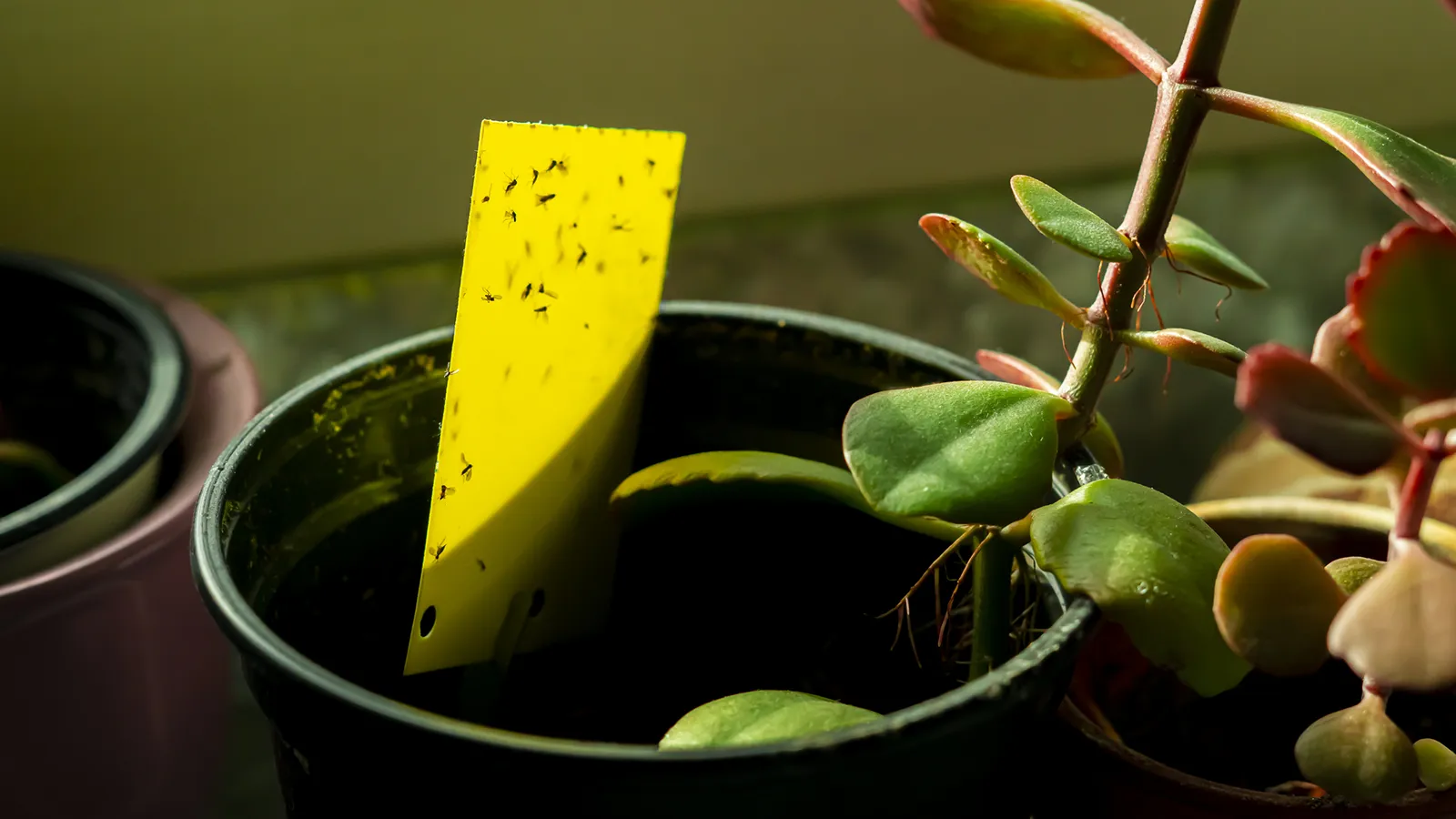
Yellow sticky traps attract and capture adult fungus gnats.
They can be useful for monitoring activity and reducing the number of adults in an area.
However, larvae remain in the growing medium.
This means sticky traps alone may not eliminate an established population.
The Colorado State University Extension guide to fungus gnats explains why adult monitoring and larval management play different roles.
The Difference Between Adult and Larval Control
| Management method | What it addresses | Important limitation |
| Yellow sticky cards | Adult monitoring and capture | Doesn’t directly control larvae in the soil |
| Appropriate moisture management | Conditions supporting larval development | Must respect the plant’s watering needs |
| Drainage corrections | Excessive moisture in containers | May require changes to the planting system |
| Beneficial nematodes | Fungus gnat larvae living in moist growing media | Require appropriate handling, application conditions and moisture to remain effective |
| Surface soil replacement | Removes upper growing medium where fungus gnat eggs and larvae may be present | Does not guarantee complete removal; must avoid damaging plant roots |
| Properly labeled Bti treatment | Susceptible fungus gnat larvae | Doesn’t control adults; label directions govern use |
| Ongoing inspections | New or recurring activity | Requires follow-through and source identification |
For a commercial property, effective fungus gnat management may involve combining adult monitoring, moisture and drainage corrections, biological larval treatments, and targeted replacement of affected surface soil. The appropriate combination depends on the infestation and the growing conditions of the plants.
Office Plant Pest Control: What Should Property Managers Do?
The horticultural response is only part of the equation.
When insects are appearing around a corporate lobby or shared workspace, there’s also a practical communication problem to solve.
The office manager needs to know what’s happening and who’s responsible for addressing it.
Employees may report insects without knowing where they’re coming from.
A tenant might notice several flies near a conference room window and assume the building has a larger pest problem.
And a well-meaning staff member may try spraying the area before anyone identifies the insects.
That’s why a simple response framework is so useful.
Office Manager’s Fungus Gnat Response Checklist
- Record the location. Note the room, floor, and nearby plants.
- Document the concern. Take photographs or describe where the insects appear.
- Contact the appropriate provider. Ask the plant maintenance team or building pest professional to identify the source.
- Review recent changes. Mention new plants, watering changes, renovations, or altered HVAC conditions.
- Request a corrective plan. Confirm what will be inspected and which actions are recommended.
- Coordinate treatment. Verify building access, approvals, and any occupant communication requirements.
- Schedule follow-up. Confirm that someone will assess whether the issue has actually improved.
This approach also creates a record if a problem keeps recurring.
Mid-Article CTA: Dealing With Recurring Office Plant Problems?
A few fungus gnats may not seem like a major issue—until the same concern keeps appearing in different rooms or your facilities team spends time chasing updates.
Amlings provides commercial interior plant maintenance for Chicago-area properties, including ongoing horticultural care and proactive attention to plant health.
If your existing plant program is creating repeated concerns, Amlings can discuss the installation, environmental conditions, and appropriate ongoing care.
CTA Button: Discuss Your Plant Care Concerns
Explore Amlings’ commercial plant maintenance services.
What If the Insects Aren’t Coming From the Plants?
This is worth checking before treating an entire office plant collection.
Not every small fly around a workplace is a fungus gnat.
Fruit flies can be associated with fermenting food or organic material.
Drain flies typically develop in moist organic buildup associated with drains.
Certain fungus-associated flies may also develop in other persistently damp locations within buildings.
The University of Maryland Extension’s fungus gnat guidance recommends determining whether insects are emerging from plants or another moisture source.
If insects are appearing near break-room drains, plumbing fixtures, or mechanical equipment rather than around planters, the building’s pest-management or facilities team may need to investigate.
Don’t replace healthy office plants simply because insects are present somewhere nearby.
The first step is confirming the source.
How Can Commercial Properties Prevent Fungus Gnats?
Prevention is largely about making the environment less favorable for reproduction while keeping plants healthy.
That takes consistent attention rather than a dramatic intervention.
Use Plant-Specific Watering Practices
Plants should be watered according to their needs, not simply because it’s a scheduled service day.
Appropriate watering depends on plant species, growing medium, container size, light, temperature, and other conditions.
The goal is to supply enough moisture without keeping the growing medium unnecessarily saturated.
Keep Growing Media and Containers Clean
Remove accumulated dead leaves and plant debris as appropriate.
Inspect container liners and drainage areas.
Address standing water or persistent moisture conditions.
Clean, well-maintained plant installations are also more attractive in high-visibility commercial spaces.
Inspect New Plants Before Installation
New plants deserve attention before they’re introduced to an established collection.
Inspecting foliage and growing media can help identify pests or suspicious conditions.
Where appropriate, plants may be monitored separately before installation.
Avoid Uncoordinated Employee Watering
This is an easily overlooked issue in commercial offices.
A plant may already be receiving professional maintenance when an employee decides it looks thirsty and adds water.
Multiply that by several helpful people, and the growing medium may become wetter than intended.
Clear responsibilities can help avoid conflicting care.
Review Repeat Trouble Spots
If fungus gnats keep appearing around the same planter, there’s a reason to investigate.
Is the container draining properly?
Does the location receive less light than expected?
Is there a moisture problem unrelated to plant watering?
Repeatedly treating the visible insects without evaluating those conditions may allow the problem to continue.
Why Chicago Office Conditions Can Complicate Plant Care
Indoor plant care doesn’t stop changing just because the plants are indoors.
Commercial buildings respond to seasonal weather, occupancy, and operational demands.
During Chicago winters, reduced daylight and changing heating conditions may influence how quickly certain plants use water.
For plants receiving less usable light, growth and water demand may decline.
If irrigation isn’t adjusted appropriately, the growing medium may remain moist longer.
The solution isn’t automatically to water less across the entire building.
It’s to evaluate the actual conditions for each installation.
Large commercial properties may also have different growing environments from one floor to another.
A bright lobby, dim corridor, and interior conference room can all require different care.
Professional maintenance should account for those differences.
When Should You Call a Professional About Fungus Gnats?
A small, isolated issue may be manageable by confirming the source and adjusting appropriate care.
But some situations deserve additional professional attention.
Consider involving a horticultural or pest-management specialist when insects appear repeatedly, multiple planters are affected, plants show unexplained decline, or the origin of the insects is unclear.
A professional evaluation can help distinguish a routine plant-care issue from a situation requiring broader building investigation.
What Should You Ask Your Plant Maintenance Provider?
Consider asking:
- Have the insects been positively identified?
- Which plants or moisture sources appear to be involved?
- Are the plants receiving appropriate watering?
- Does the container drainage need attention?
- Is any treatment recommended, and who will authorize it?
- What follow-up is needed?
- How can the issue be less likely to recur?
These questions help move the conversation beyond a quick spray or a replacement sticky trap.
They also help property managers evaluate the quality of ongoing service.
How Amlings Supports Professional Office Plant Care
Amlings’ published commercial services include interior plant design, installation, and ongoing horticultural maintenance throughout the Chicago area. The company emphasizes selecting plants suited to their surroundings and providing continued care after installation.
Its documented maintenance offering includes watering, grooming, and proactive plant-health attention. These capabilities are directly relevant to preventing common growing-condition problems and recognizing when an installation needs attention.
When fungus gnats become a problem, Amlings combines horticultural knowledge with targeted treatment methods to address the infestation.
Our team uses Bti and beneficial nematodes to target fungus gnat larvae in the growing medium. We also typically replace the top few inches of moist soil when appropriate, helping remove material where eggs and developing larvae may be present.
These treatments complement the broader plant-care practices that help prevent recurring infestations, including monitoring soil moisture, evaluating drainage, and adjusting watering according to each plant’s needs.
For Chicago property managers and facilities teams, this approach means looking beyond the flying insects to address the conditions contributing to the problem.
Frequently Asked Questions About Fungus Gnats in Office Plants
1. Do fungus gnats bite employees or office visitors?
No. Adult fungus gnats do not bite people.
They’re generally considered nuisance insects rather than a biting pest.
However, the presence of flying insects can understandably cause concern in a shared workplace.
2. Are fungus gnats the same as fruit flies?
No.
They can appear similar at first glance, but fungus gnats are commonly associated with damp soil, while fruit flies are often associated with fermenting organic material.
Identification matters because the source and appropriate management can differ.
3. Can fungus gnats spread between office plants?
Yes.
Adult fungus gnats can move between nearby containers and lay eggs in suitable moist growing media.
This is one reason to inspect adjacent plants when an infestation is discovered.
4. Should an infested office plant be thrown away?
Not automatically.
Many infestations can be managed by correcting environmental conditions and using appropriate control measures.
Replacement may be considered if the plant is severely declining, the growing medium is unsuitable, or repeated interventions are unsuccessful.
The decision should account for both plant health and the needs of the property.
5. How long does it take to eliminate fungus gnats?
There is no reliable universal timeline.
Results depend on the extent of the infestation, environmental conditions, treatment approach, and whether the underlying source has been corrected.
Because multiple life stages may be present at once, monitoring after initial treatment is important.
6. Can fungus gnats come from drains or other damp building areas?
Some fungus gnats can develop in suitable moist organic material outside plant containers.
Other small flies, including drain flies, may also be involved.
If the source is uncertain, a qualified pest-management or building professional should investigate rather than assuming the office plants are responsible.
7. Can employees use insect spray to get rid of fungus gnats?
Employees should not apply pesticides in shared commercial spaces without appropriate authorization.
Not all products are suitable for occupied environments, and treating adult insects alone may fail to resolve larvae in the growing medium.
Building-approved procedures and product-label requirements should guide any treatment.
Keep the Plants. Lose the Recurring Problems.
Office plants should make your property look more inviting—not create another problem for the facilities team to manage.
When fungus gnats appear, the most important step is understanding why.
Sometimes the solution involves correcting moisture conditions.
Sometimes additional pest management is appropriate.
And sometimes the real source isn’t the plants at all.
The goal is to identify the problem, take the appropriate action, and prevent unnecessary disruption.
Amlings works with Chicago-area commercial properties to design, install, and maintain interior plant displays.
If you’re dealing with recurring plant-health concerns or wondering whether your existing maintenance arrangement is delivering the care your property needs, Amlings can help you explore your options.
A conversation can clarify your current installation, recurring trouble spots, environmental conditions, and what a suitable ongoing care program could involve.
Ready to discuss a better approach to caring for your office plants?